

Cart
0
Table of Contents
- What Makes Fine Jewelry Sustainable?
- Lab-Grown Diamond Certification Standards: What IGI Reports Actually Prove
- How to Store Fine Jewelry to Prevent Scratching
- Supply Chain Transparency and Third-Party Certification
- Carbon Footprint and Circularity: What Most Brands Skip
- A Consumer Verification Checklist Before You Buy
- Frequently Asked Questions
Last Updated: September 10, 2026
What Makes Fine Jewelry Sustainable?
Sustainable fine jewelry is jewelry produced in a way that limits environmental harm and protects the people who mine, cut, and assemble it. That definition covers three fronts at once: where the metal comes from, where the stones come from, and whether anyone can prove either claim. This guide from Native Jewel walks through each one.
The category has grown fast, and so has the confusion around it. A ring can be "eco-friendly" in its marketing and still contain newly mined gold with no traceable origin. Below, we'll show you exactly how to separate the two, starting with the metal itself.
Recycled Precious Metals vs. Newly Mined Gold
Recycled gold comes from existing jewelry, industrial scrap, and electronic waste that is refined back to purity. It performs identically to newly mined gold because the element does not degrade, and it avoids the excavation footprint entirely.
Newly mined gold is a different story. Extracting it moves enormous volumes of rock, and small-scale artisanal mining often relies on mercury to separate gold from ore. A common mistake is assuming "recycled" means lower quality. It does not. Ask a jeweler for the refiner's name and whether the metal is certified recycled, not just described that way.
Ethical Diamond Sourcing and Conflict-Free Verification
Conflict-free means a diamond did not finance armed conflict, and verification is what makes that claim meaningful. The Kimberley Process is the baseline, but it has well-documented gaps, so serious buyers look for a second layer: a grading lab report that ties a specific stone to specific measurements.
Lab-grown diamonds sidestep the question almost entirely. They are created in a facility, not extracted from the ground, so their origin is documented from the start. Native Jewel builds its collection around IGI-certified lab-grown stones for exactly this reason.
Lab-Grown Diamond Certification Standards: What IGI Reports Actually Prove
An IGI report proves that an independent gemologist examined a specific stone and recorded its measurements. It is not a brand's opinion of its own product. Each report carries a unique number, and you can look it up directly in the IGI database to confirm the stone matches the paperwork.
Here is what a report does not prove: that the price was fair, that the setting is well made, or that the seller treated its workers well. Those require separate questions. Treat the report as one verified fact, not the whole story.
Reading a Grading Report: Color, Clarity, Cut, Carat
Four grades carry most of the weight, and reading them in order tells you what you are actually buying.
| Grade | What It Measures | What to Look For |
|---|---|---|
| Color | Absence of tint | D to F reads colorless to the eye |
| Clarity | Internal inclusions | VS1 and above are clean under magnification |
| Cut | Light performance | Excellent is the top grade |
| Carat | Weight, not size | Spread varies by shape at equal weight |
A 3.6ct oval in D color, VS1 clarity, and Excellent cut sits at the top of the scale on all four, which is why the report matters more than the marketing copy beside it.
Lab-Grown vs. Natural Gemstones: Cost, Origin, and Resale
Lab-grown stones cost less than mined stones of comparable grade, largely because growing one takes weeks rather than extracting it from deep rock. Origin is fully documented. Resale is the honest caveat: both lab-grown and natural diamonds trade well below retail on the secondary market, so buy for wear, not for investment.
Watch Out
Do not buy a diamond as a financial asset. Neither lab-grown nor natural stones reliably resell near retail price, and sellers who frame a ring as an investment are setting you up for disappointment.
How to Store Fine Jewelry to Prevent Scratching
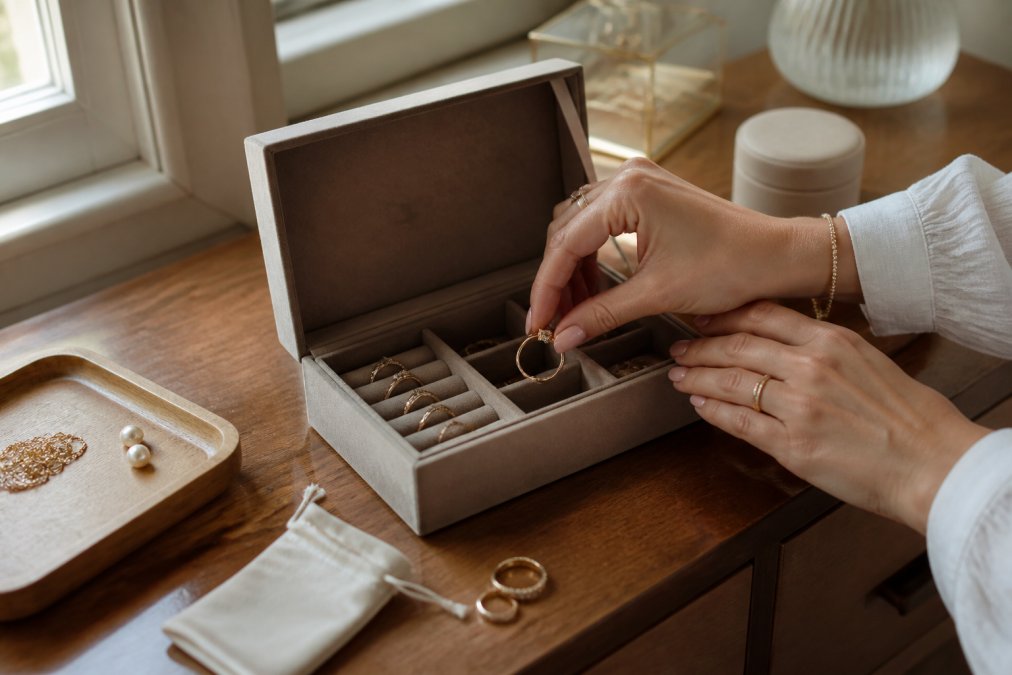
Store each piece in its own soft pouch or compartment so harder stones never contact softer metal. Diamonds sit at the top of the Mohs scale and will scratch gold, platinum, and softer gemstones on contact. A shared jewelry box is the single most common cause of surface damage.
A few habits prevent most damage:
- Keep pieces separated, never loose in one tray
- Fasten chains before storing to stop tangling
- Put jewelry on last, after perfume and hairspray
- Remove rings before cleaning, gardening, or the gym
- Wipe pieces with a soft cloth before they go back in the box
For 14K gold, this matters more than most people expect. Fourteen-karat gold is an alloy, harder than 24K but still softer than a diamond, so a loose stone in the same compartment will leave fine scratches over time.
Supply Chain Transparency and Third-Party Certification
Transparency means a brand can name its refiner, its stone grower or supplier, and its assembly workshop. Third-party certification means an outside body verified part of that chain rather than the brand grading its own homework. The Responsible Jewellery Council sets member standards for exactly this, and IGI reports cover the stone itself.
The gap most buyers miss is between the two. A certified stone can still sit in a setting made under conditions nobody documented. Ask both questions: what is certified, and who certified it.
Pro Tip
Ask for the refiner's name, not just "recycled gold." A brand that can name its refiner has a traceable chain. A brand that only uses the word "recycled" usually cannot tell you where the metal came from.
Carbon Footprint and Circularity: What Most Brands Skip
Few brands publish an actual carbon figure, and that silence is the tell. Quantifying footprint means measuring the energy behind growing or mining a stone, refining the metal, and shipping the finished piece. Most sustainability pages stop at the word "eco-friendly" and never reach a number. This section is about what a credible number would even look like, and what to do with a piece once you own it.
What a Real Footprint Number Requires
A carbon footprint for a piece of jewelry is the sum of emissions across its life, expressed as carbon dioxide equivalent (CO2e). The major contributors are usually the same across brands: metal extraction or refining, stone growth or mining, fabrication and setting, and transport. For lab-grown stones, the energy source behind the growth process is the single largest variable, a facility powered by a low-carbon grid produces a very different stone than one powered by coal, even though the stone itself is identical. For mined stones, the mining and sorting stages dominate.
A credible figure has three properties. First, it states a boundary: which stages are included and which are excluded. A number that covers only the brand's own workshop and ignores upstream mining is not a footprint, it is a partial inventory. Second, it states a method: emissions factors, grid assumptions, and whether the result was independently verified. Third, it states a unit and a basis: kilograms of CO2e per piece, or per carat, or per gram of metal. Without all three, a number is decoration.
Most practitioners find that the honest answer for many brands is that they do not have a verified figure yet, and that is a more useful answer than a vague claim. "We have not measured it" is a starting point. "Eco-friendly" is not.
Circularity Is the Harder Half
Circularity means the material in a piece stays in use instead of sitting in a drawer or a landfill. In fine jewelry, that happens through four mechanisms, and a brand that offers none of them is not circular regardless of what its sourcing page says.
- Trade-in and buyback. The brand takes a piece back, credits the customer, and returns the metal and stones to its supply chain. This is the most direct form of circularity because it recovers material the brand already sold.
- Repair and restoration. Re-tipping prongs, re-sizing, re-polishing, and replacing worn clasps extend a piece's life by decades. A brand with a repair program is keeping material out of the waste stream.
- Reset and redesign. Reusing an inherited stone in a new setting recovers the highest-value component without re-mining or re-growing it. This is common in estate and heirloom work and rare in new-retail brands.
- Recycling. When a piece is truly beyond repair, the metal can be refined back to purity and re-entered into the supply chain. Stones can sometimes be re-cut, though this is less common.
The practical question to ask before you buy is simple: what happens to this piece at end of life, and does the brand have a program for it? If the answer is "the customer keeps it," that is not circularity, that is a drawer.
Why End-of-Life Planning Is Rare
End-of-life programs are expensive to run and slow to show returns, which is why most brands skip them. A trade-in program requires inventory management, valuation, and refining relationships. A repair program requires bench jewelers on staff or on contract. Both cut into margin. The brands that offer them tend to be either large enough to absorb the cost or small enough to run them as a core part of the business.
For a buyer, this is a useful filter. A brand that publishes a repair policy, a warranty that covers structural work, and a stated trade-in or reset option has thought about the back half of the product's life. A brand that only talks about sourcing has thought about the front half. Sustainability is both.
Key Takeaway
Ask three questions before you buy: Does the brand publish a carbon figure with a stated boundary and method? Does it offer repair or trade-in? What happens to the piece when you are done with it? The answers tell you more than any sustainability page.
What This Means for Your Purchase
You do not need a brand to be perfect on every axis. You need to know which axes it is actually working on and which it is only claiming. Carbon data and circularity are the two areas where the gap between claim and practice is widest, which makes them the two best questions to ask. A brand that answers them directly, even with "we are still measuring," is more trustworthy than one that answers with adjectives.
A Consumer Verification Checklist Before You Buy
Run this checklist before any purchase, and you will catch the claims that do not hold up.
- Ask for the IGI report number and verify it in the IGI database yourself
- Confirm the metal is certified recycled and ask for the refiner's name
- Ask whether the setting workshop is audited by a third party
- Request any published carbon or footprint data, and note if none exists
- Ask what happens to the piece at end of life, including trade-in or reset options
- Confirm the return window and resize policy in writing before ordering
- Check whether the warranty covers repairs and for how long
Native Jewel covers several of these directly: every diamond piece ships with an IGI certificate, the collection uses ethically sourced materials, and all diamond jewelry carries a lifetime warranty with a 30-day return window. For a piece like the Oval Lab Grown Diamond Engagement Ring at $2,500, that paperwork is the difference between a claim and a fact.

Frequently Asked Questions
What makes fine jewelry sustainable?
Sustainable fine jewelry rests on three things: where the metal and stones come from, how the piece is made, and how long it lasts. Recycled gold and platinum reduce mining demand, lab-grown diamonds avoid large-scale extraction, and third-party certification proves the claims. Durability matters too, since a 14K gold ring worn for decades has a far smaller footprint than a trend piece replaced every two years. Ask for documentation on sourcing, labor practices, and certification before you buy.
Are lab-grown diamonds considered sustainable?
Lab-grown diamonds are created in a controlled facility rather than extracted from the ground, so they avoid open-pit mining, habitat disruption, and the water use tied to large-scale extraction. They are chemically and optically identical to mined diamonds and are graded on the same color, clarity, cut, and carat scale. Look for IGI certification to confirm the stone's specifications, and ask the brand how its growers power their production, since energy source is where lab-grown diamonds vary most.
How can I tell if a jewelry brand is truly ethical?
Ask for paperwork, not promises. A credible brand provides IGI or equivalent grading reports, names its metal refiners, and can explain where stones originate. Check whether the brand publishes a supply chain audit or a responsible sourcing policy, and whether it belongs to an industry body with enforceable standards. Vague language about being eco-friendly without documentation is a warning sign. Also look at after-sale support: lifetime warranties, resizing, and repairs signal a brand expecting the piece to last.
What is the difference between recycled gold and mined gold?
Recycled gold is refined from existing jewelry, industrial scrap, and electronic waste rather than pulled from new mines. Chemically it is identical to mined gold, so a 14K recycled gold ring wears the same and holds the same value. The difference is upstream: recycled gold avoids new excavation, the associated habitat loss, and the mercury and cyanide used in some artisanal mining operations. Refiners typically verify content through assay, and hallmarking confirms the karat purity stamped on the finished piece.
Is 14K gold a sustainable choice for fine jewelry?
14K gold is 58.3% gold alloyed with metals like copper and silver, which makes it harder than 18K or 24K and better suited to daily wear. A ring that resists scratching and deformation stays in use longer, which is the core of circularity. It also costs less per gram than higher-karat gold, so more of your budget goes toward the stone. Pair it with recycled gold sourcing and IGI-certified lab-grown diamonds, and you get heirloom-quality durability without new mining demand.
The hard part of buying sustainable fine jewelry is not finding a brand that says the right words. It is finding one that hands you the documents behind them. Native Jewel was built around that idea: IGI-certified lab-grown diamonds, ethically sourced 14K gold, handcrafted settings, a lifetime warranty on every diamond piece, and a 30-day return window if the ring is not right. Browse the collection and start with a piece you can verify, not just admire.


