

Cart
0
Table of Contents
- Lab Grown Diamond vs Cubic Zirconia: Side-by-Side Comparison
- Are Lab Grown Diamonds Real Diamonds?
- Hardness and Durability: The Mohs Scale Test
- Cost Comparison: Price Per Carat and Long-Term Value
- Lab Grown Diamond Resale Value vs Cubic Zirconia
- IGI Certification for Lab Diamonds: Your Proof of Quality
- What to Choose for an Engagement Ring
- Frequently Asked Questions
Last Updated: September 6, 2026
Lab Grown Diamond vs Cubic Zirconia: Side-by-Side Comparison
A lab grown diamond is a real diamond created in a laboratory that replicates natural formation, while cubic zirconia is a synthetic gemstone that only simulates a diamond's appearance. These two stones sit at opposite ends of the fine jewelry spectrum despite looking similar. In this guide from Native Jewel, we'll show you how to tell them apart, what each is worth, and which belongs on your engagement ring.

The differences go far beyond price. A lab grown diamond shares the same chemical composition, crystal structure, and optical properties as a mined diamond, which is why the Federal Trade Commission's guidance on diamond terminology recognizes them as genuine diamonds. Cubic zirconia, by contrast, is a diamond simulant, a material that mimics the look of diamond without sharing its physical or chemical identity. Below, we'll break down the seven factors that decide this comparison, from hardness to resale value, so you can make a confident choice.
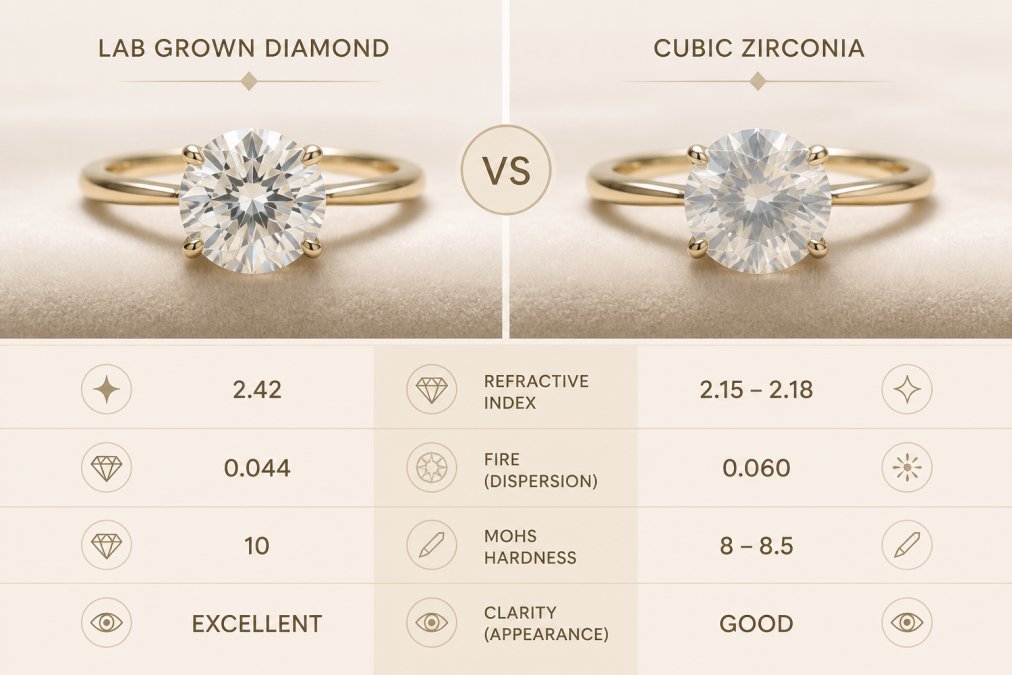
| Property | Lab Grown Diamond | Cubic Zirconia |
|---|---|---|
| Chemical Composition | Carbon lattice | Zirconium dioxide |
| Hardness (Mohs) | 10 | 8-8.5 |
| Refractive Index | 2.42 | 2.15-2.18 |
| Brilliance | Exceptional fire and scintillation | Lower dispersion, glassy look |
| Durability | Suitable for daily wear | Prone to scratches and cloudiness |
| Certification | IGI certified | None |
| Resale Value | Retains meaningful value | Negligible |
Are Lab Grown Diamonds Real Diamonds?
Yes, lab grown diamonds are real diamonds, chemically and optically identical to stones formed underground. The only difference is origin: a lab grown diamond is produced in weeks using technology that replicates the high-pressure, high-temperature conditions of the earth's mantle. This creates a genuine carbon lattice, the same structure found in natural diamonds, which is why even trained gemologists need specialized equipment to distinguish them.

What a lab grown diamond is not is a simulant like cubic zirconia or moissanite. Simulants merely imitate a diamond's appearance, while lab grown diamonds possess the same hardness, thermal conductivity, and light reflection that define the gemstone. For shoppers asking "are lab grown diamonds real," the answer is a definitive yes.
Key Takeaway
When jewelers say a stone is "lab grown," they mean it is a genuine diamond with verified physical properties, not a lookalike. Cubic zirconia is the lookalike, and the two should never be confused in quality discussions.
Hardness and Durability: The Mohs Scale Test
The hardness gap is the single biggest practical difference for everyday wear. On the Mohs scale, a lab grown diamond scores a perfect 10, while cubic zirconia ranks between 8 and 8.5. That gap translates into real-world durability: a diamond resists scratching, whereas cubic zirconia will accumulate surface abrasions and lose its polish over time.
The Mohs scale is ordinal, not linear, the jump from 8.5 to 10 represents a far greater leap in absolute hardness than from 7 to 8.5. Ordinary dust, which contains quartz particles ranking 7, will scratch cubic zirconia over time. A lab grown diamond, by contrast, is impervious to everything you'll encounter in daily life.
Cubic zirconia doesn't just scratch, it clouds from the inside out. Because CZ is porous at the microscopic level, it absorbs oils, lotions, and soap residues that accumulate within its structure. A CZ ring that sparkles on day one looks hazy and dull after 12 to 18 months of regular wear. The cloudiness isn't a surface film you can wipe away; it's permanent degradation of the stone's internal clarity.
A lab grown diamond, being a single crystal of pure carbon, has no such porosity. Its internal structure is completely inert, so it will never cloud, yellow, or degrade from everyday exposure. The only way to damage it is to chip it along an existing cleavage plane, a rare event requiring a sharp, forceful blow, or to subject it to extreme heat.
Watch Out
If you're considering cubic zirconia for an [engagement ring](/products/5-06-cttw-oval-cut-diamond-igi-certified-14k-yellow-gold-engagement-ring), understand that the stone you see on day one is not the stone you'll have in five years. CZ's internal clouding is irreversible and cannot be repaired by professional cleaning or polishing. The only remedy is replacement.
For an engagement ring worn daily, this matters enormously. A cubic zirconia stone will show visible wear and reduced brilliance within a couple of years. A lab grown diamond maintains its fire and scintillation for a lifetime with proper care. The longevity difference alone often justifies the higher upfront investment.
Cost Comparison: Price Per Carat and Long-Term Value
Lab grown diamonds cost significantly less than mined diamonds of equivalent quality, often 60 to 70 percent less, but they still represent a substantial investment. Cubic zirconia is inexpensive to produce and sells for a fraction of the price, which is why it appears in fashion jewelry rather than heirloom pieces.
A cubic zirconia ring is a disposable fashion item; when the stone clouds or scratches, the piece carries no lasting value. A lab grown diamond, however, is a genuine gemstone that holds meaning and retains measurable worth. At Native Jewel, our IGI-certified rings, such as the 3.6ct Oval Cut Lab Grown Diamond IGI Certified 14K White Gold Engagement Ring at $2,500.00, deliver the brilliance of a high-carat diamond without traditional retail markups.
| Ring Option | Stone Type | Carat Weight | Price |
|---|---|---|---|
| Oval Cut, 14K White Gold | Lab Grown Diamond | 3.6 CTTW | $2,500.00 |
| Pear Cut, 14K Yellow Gold | Lab Grown Diamond | 3.55 CTTW | $3,500.00 |
| Radiant Cut, 14K Yellow Gold | Lab Grown Diamond | 5.11 CTTW | $4,500.00 |
| Elongated Emerald Cut, 14K Yellow Gold | Lab Grown Diamond | 2.25 CTTW | $2,200.00 |
Lab Grown Diamond Resale Value vs Cubic Zirconia
Lab grown diamond resale value is nuanced, but the short answer is that a lab grown diamond retains meaningful value while cubic zirconia holds essentially none. Cubic zirconia has no secondary market; once purchased, it is worth only what the metal setting carries. A lab grown diamond can be sold, traded, or repurposed, and while it does not appreciate like a mined diamond, it maintains a recognizable portion of its value.
The key distinction comes down to certification. An IGI-certified lab grown diamond carries documented proof of its quality, making it appraisable and insurable. Cubic zirconia has no such documentation because it has no intrinsic gemstone value. The practical advice is to purchase certified stones and keep the paperwork, as this protects your investment and your ability to insure the piece.
What Insurance Companies Actually Cover
Will your insurance policy replace a cubic zirconia if you lose it? Standard homeowners and renters policies typically cover jewelry up to a modest limit, often $1,000 to $2,000, but to insure a valuable piece beyond that, you need a scheduled personal property rider or a standalone jewelry policy.
When you schedule a piece, the insurer requires a professional appraisal documenting the stone's identity, quality, and replacement value. A lab grown diamond can be appraised and scheduled without issue because it is a genuine gemstone with verifiable characteristics. Insurers recognize IGI certification as proof of identity and quality, and they will cover loss, theft, or damage at full replacement value.
Cubic zirconia presents a different problem. Most insurers will not schedule a CZ piece because the stone has no intrinsic value. If you lose a CZ ring, your policy will only cover the metal setting. Some insurers won't write a rider at all because the replacement cost is so low. In practice, a CZ ring is effectively uninsurable as jewelry; it's a fashion item, not an asset.
The Appraisal Reality
A certified gemologist appraising a lab grown diamond will document its 4 Cs, measure its dimensions, note its fluorescence, and assign a replacement value based on current market prices. That appraisal is a legal document you can present to an insurer, a bank, or a potential buyer.
For cubic zirconia, a professional appraisal is essentially meaningless. An appraiser can identify the stone as CZ and note its weight, but there is no market data for "used cubic zirconia" because no secondary market exists. The appraisal will state that the stone has nominal value and that only the setting contributes to the piece's worth.
Key Takeaway
Before you buy, ask yourself: do I want a stone I can insure, appraise, and potentially sell, or a stone that is disposable by design? If the answer is the former, a certified lab grown diamond is the only choice between these two options.
The Five-Year Cost of Ownership
Let's do the math that most guides skip. A quality cubic zirconia ring in a 14K gold setting might cost $300 to $600. A comparable lab grown diamond ring with IGI certification might cost $2,000 to $4,000. Consider what happens over five years of daily wear:
- Cubic zirconia: The stone will cloud and scratch within 12 to 24 months. Replacing the stone costs $50 to $150 each time, plus jeweler labor. Over five years, you'll likely replace the stone two to three times, adding $150 to $450 to your total. The ring still has no resale value, and if you lose it, your insurance won't replace the stone.
- Lab grown diamond: The stone will look identical on day five as it did on day one. No replacement needed. The ring retains its appraised value, can be insured for full replacement cost, and can be sold or traded if you ever decide to upgrade.
When you factor in replacement costs, insurance premiums, and the complete absence of resale value for CZ, the "cheap" option often costs more per year of beautiful wear than the lab grown diamond. The upfront price difference narrows considerably when you measure cost over the lifetime of the piece.
IGI Certification for Lab Diamonds: Your Proof of Quality
IGI certification for lab diamonds is the industry standard that verifies a stone's authenticity and quality, and it is the single most important document you can own with a lab grown diamond purchase. The International Gemological Institute grades each stone using the same rigorous criteria applied to mined diamonds: the 4 Cs. This certification provides an objective, third-party record that the stone is a genuine lab grown diamond and not a simulant.
When you buy a certified stone, you receive a grading report that travels with the diamond for life. This report enables insurance, resale, and professional appraisal, all impossible with an uncertified stone like cubic zirconia. Every lab grown diamond engagement ring from Native Jewel comes with IGI certification, along with a lifetime warranty on all diamond jewelry. The 5.06 CTTW Oval Cut Diamond IGI Certified 14K Yellow Gold Engagement Ring at $4,500.00 exemplifies this commitment.

Watch Out
Never purchase a lab grown diamond without third-party certification. An uncertified stone cannot be independently verified as a genuine diamond, cannot be properly insured, and will be nearly impossible to sell later. Always demand IGI or equivalent grading documentation.
What to Choose for an Engagement Ring
For an engagement ring, the choice is clear: choose a lab grown diamond over cubic zirconia if you want a piece that will endure daily wear, hold its beauty, and carry lasting significance. Cubic zirconia may appeal to a tight budget, but its softness, cloudiness over time, and lack of resale value make it a poor choice for a symbol meant to last decades.
An engagement ring is not a fashion accessory you replace seasonally; it is an heirloom in the making. Customers who choose Native Jewel consistently remark on the quality, with one noting, "The ring is even more beautiful in person. The sparkle is incredible, the setting feels premium, and the craftsmanship is exceptional." When you select a lab grown diamond, you invest in a stone that will sparkle for generations, not a simulant that will fade.
Pro Tip
When selecting a lab grown diamond, prioritize cut quality above all other factors. An Excellent cut maximizes light reflection and brilliance, making a well-cut stone appear larger and more vibrant than a poorly cut stone of higher carat weight.
For a truly personalized piece, explore options like the 3.55ct Total Weight Pear Cut Lab Grown Diamond IGI Certified 14K Yellow Gold Engagement Ring at $3,500.00 or the 2.25 CTTW Elongated Emerald Cut Lab Grown Diamond IGI Certified 14K Pave Yellow Gold Engagement Ring at $2,200.00. Each handcrafted design combines ethical sourcing with exceptional craftsmanship, backed by a 30-day hassle-free return policy and free shipping on orders over $1,999.
Choosing between a lab grown diamond and cubic zirconia ultimately comes down to what you want your jewelry to represent. If you value a genuine, certified gemstone that will withstand decades of daily wear and hold its meaning and worth, a lab grown diamond is the only real choice. Native Jewel offers a curated collection of IGI-certified lab grown diamond rings in luxurious 14K gold, handcrafted with ethical sourcing. Get started with Native Jewel and find a ring that will sparkle as brilliantly as the moment it represents.
Frequently Asked Questions
Can a jeweler tell the difference between lab grown and real diamonds?
Yes, a jeweler using standard testing equipment can tell the difference between a lab grown diamond and a cubic zirconia. A diamond tester measures thermal conductivity, and a cubic zirconia will not register as a diamond. Distinguishing a lab grown diamond from a mined diamond requires more advanced spectroscopy equipment because they share the same physical and optical properties.
Does cubic zirconia get cloudy over time?
Yes, cubic zirconia can get cloudy over time. This cloudiness is not a surface issue; it is caused by microscopic scratches on the stone's facet edges. Because cubic zirconia is softer than diamond and lacks the same toughness, its polished surface dulls with regular wear. Cleaning will not restore the original clarity once the surface has been abraded.
What is the resale value of a lab grown diamond?
A lab grown diamond has a resale value, but it is typically lower than its original retail price, similar to mined diamonds. The market for pre-owned lab grown diamonds is still developing. However, the stone retains value and can be traded or sold. A cubic zirconia has no resale market value once purchased. IGI certification helps establish provenance and quality for any future transaction.
Is cubic zirconia a fake diamond?
Cubic zirconia is classified as a diamond simulant, not a fake diamond. A simulant is a material that looks like a diamond but has a different chemical composition and crystal structure. Cubic zirconia is zirconium dioxide, while a diamond is pure carbon. It mimics the look of a diamond but does not share its hardness, durability, or optical performance.
Are lab grown diamonds as hard as natural diamonds?
Yes, lab grown diamonds are as hard as natural diamonds. Both score a 10 on the Mohs hardness scale, making them the hardest known natural material. This means a lab grown diamond is suitable for daily wear and will not scratch or dull like softer simulants. The cutting process, not the origin of the stone, determines the final durability.


